

Let’s be honest. “Agility” sounds like something you put on a slide.
But if you’re building complex products, agility is painfully real.
It’s the difference between shipping the right configuration… and shipping a surprise.
Between a supplier working from the latest release… and a supplier working from “whatever was in the email thread”.
And it usually breaks in the same place.
Data.
Not the amount of data. The trust in it. The control around it. The ability to share it quickly without losing your grip on IP, compliance, or change history.
So let’s talk about what supply chain agility actually means in product development, and what you can do about it.
Key points
- Supply chain agility is built on fast, trusted decisions, not just fast workflows.
- The biggest blocker is usually uncontrolled product data sharing across organisational boundaries.
- ShareAspace helps OEMs and primes integrate, govern, and share product information with suppliers in a controlled way.
- You get configuration control, traceability, access rights, and assured data across the supply chain.
- The same foundation also supports Digital Product Passport readiness.
Why supply chain agility matters in product development
Product development doesn’t happen inside one tool, one team, or one company. It happens across a value network.
Design. Manufacturing. Procurement. Quality. Support. Suppliers. Subcontractors.
Now add the real-world pressure:
- Requirements change late.
- Lead times move.
- Parts get substituted.
- Regulations tighten.
- Programmes get audited.
- Someone always needs an answer “today”.
In that environment, agility is the ability to respond quickly without losing control.
Because moving fast is easy when you don’t care about governance.
Moving fast and staying right is the hard bit.
What gets in the way
Most supply chains don’t struggle because people don’t want to collaborate.
They struggle because collaboration becomes risky.
A few familiar patterns:
- Multiple versions of the truth: different part structures in different systems, different exports, different interpretations.
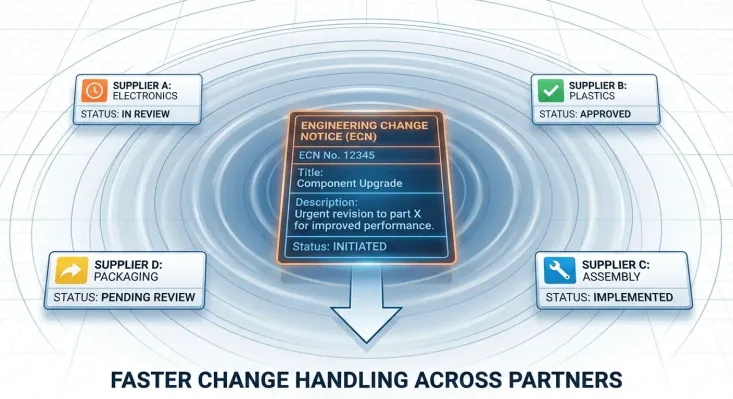
- Unclear change status: is this approved, in review, or obsolete? Who signed off? When?
- IP and contract boundaries: you want to share what’s needed, but not everything.
- Compliance constraints: export control, customer restrictions, audit requirements.
- Manual handovers: spreadsheets, PDFs, zipped files, and “please see attached final FINAL v7”.
It’s like trying to build a house where every contractor brings their own blueprint… and none of them match.
How ShareAspace enables agile, secure collaboration
ShareAspace is built to do something specific and valuable: create a controlled way to integrate and share product lifecycle information across organisations, with governance baked in.
Think of it as a secure collaboration layer that helps you:
- connect data from PLM, CAD, ERP, and asset systems
- control what’s shared, with whom, and under what rules
- maintain traceability and configuration change control through-life
- keep a clear audit trail so teams can act with confidence
What this looks like in practice
1) Maintain control while collaborating
You can share the right information without giving away the keys to the kingdom.
- granular access rights based on roles, contracts, programmes, or partners
- protection of sensitive product information and intellectual property
- structured sharing that fits how complex programmes actually operate
2) Trust the data you’re using
Agility collapses when teams don’t trust what they see.
- assured, decision-ready product information
- traceability through-life, including who changed what and when
- clearer configuration status across extended teams
3) Collaborate faster with fewer “translation” steps
You reduce the back-and-forth that slows programmes down.
- shared views of product structures and related information
- streamlined supplier onboarding and handovers
- less time chasing files, more time resolving issues
What this unlocks for OEMs and primes
When your supply chain collaboration is governed and secure, a few things start to happen:
- Faster response to change
Because you’re not rebuilding trust every time a change notice lands. - Cleaner supplier execution
Because suppliers aren’t guessing which version is current. - Fewer late surprises
Because decisions are based on consistent, traceable information. - Better programme resilience
Because you can adapt without losing compliance or control.
That’s what “agility” is supposed to feel like.
From agility to making Digital Product Passports real
Here’s the interesting part.
The same foundation that makes a supply chain agile also makes Digital Product Passports achievable.
Because a passport isn’t magic. It’s not a PDF. It’s not a one-off data dump.
It’s a living set of product information that has to be:
- complete enough to be credible
- controlled enough to be safe
- current enough to be useful
- traceable enough to stand up to scrutiny
If you’re thinking about how to move from theory to execution, this follow-on piece goes deeper into the “how” and the practical realities teams run into.
Learn more: Make Digital Product Passports real
Executive summary
Supply chain agility isn’t just about speed. It’s about making fast decisions you can trust, across organisations, without losing control of IP, compliance, or configuration.
ShareAspace helps OEMs and primes integrate and securely share product lifecycle information with suppliers and partners, enforcing access rights, traceability, and configuration change control. The result is simpler collaboration, fewer errors, and a stronger digital thread through-life.
And as a bonus, it puts you in a much better position to make Digital Product Passports real, without turning your organisation into a spreadsheet factory.